

Cart
0
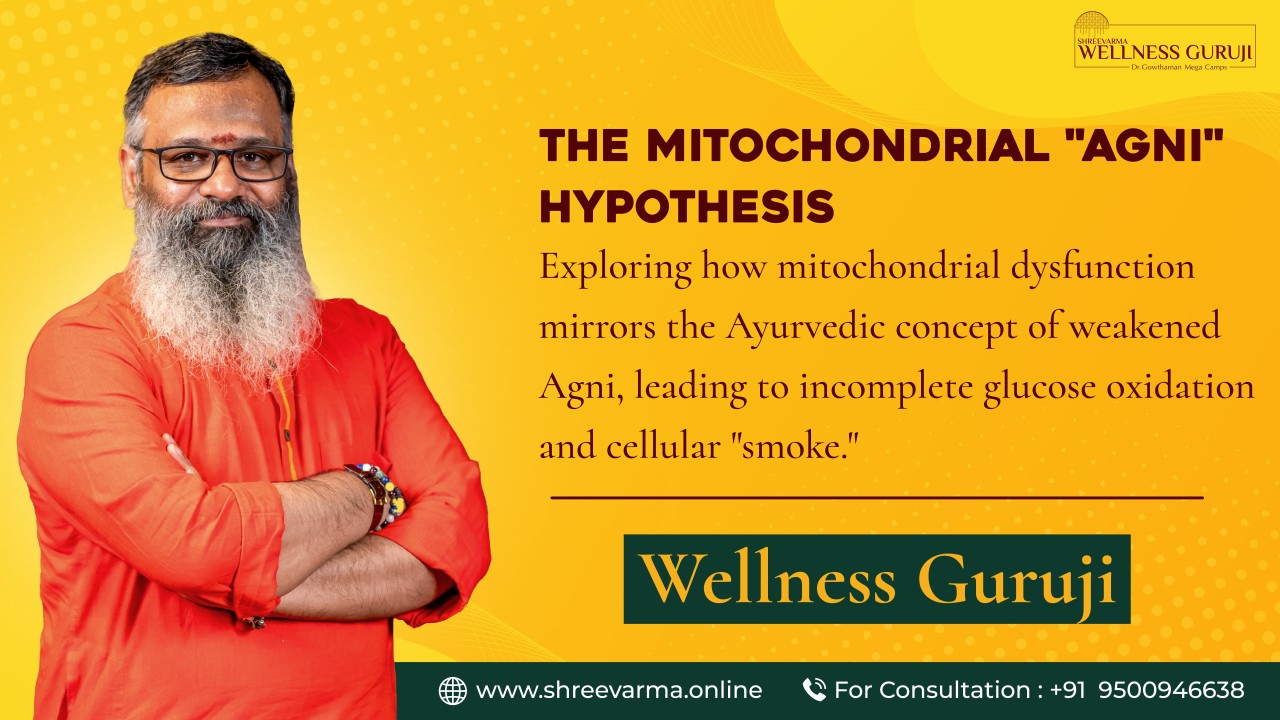
Namaste, my friends.
It is a joy to gather with such a refined group of seekers—those of you who bridge the gap between the ancient wisdom of the Vedas and the rigorous precision of modern biochemistry.
Today, we are going to embark on a journey of deep synthesis. We are going to look at the Mitochondrion, not just as an organelle under a microscope, but as the literal seat of Agni—the sacred biological fire—within the cellular temple. When this fire flickers or becomes smothered, we do not just see "low ATP"; we see the production of Ama (metabolic "smoke") that clouds our vitality and leads to the chronic "dis-ease" states of our modern era.
The Invocation
The Fractal Nature of Agni: From Macrocosm to the Micro-Havan
In the ancient Vedic tradition, we speak of Agni—the god of fire. But to the Ayurvedic physician, Agni is not a deity residing in the heavens; it is the fundamental principle of transformation. It is the intelligence that converts food into flesh, thoughts into wisdom, and oxygen into life.
We are taught about Jatharagni, the central digestive fire located in the gut. For centuries, this was the primary focus of metabolic health. However, Ayurveda is a science of fractals. Just as the universe is reflected in the soul, the central fire of the gut is reflected in the cellular fire of the tissues—what we call Dhatu Agni.
As highly educated professionals, you recognize this "cellular fire" by its modern, biological name: Mitochondrial Function.
The mitochondrion is the literal "Havan Kund" (sacrificial pit) of the cell. Within its double-membraned sanctuary, a constant ritual of transformation occurs. We offer Ahuti—the offerings of glucose and fatty acids—and through the sacred "breath" of oxygen, these substrates are converted into the currency of life, ATP. This is the ultimate expression of Prana becoming Shakti.
However, we find ourselves in a modern crisis of "Smothered Agni." In our professional worlds, we are often sedentary, over-stimulated, and fueled by "damp wood"—processed, high-glycemic fuels that do not burn cleanly. When the fire in the kitchen (the gut) is weak, or when the cellular pits (the mitochondria) are overwhelmed, the transformation is incomplete.
In Ayurveda, we call this incomplete transformation Ama. In your clinics and laboratories, you call it Metabolic Waste, Reactive Oxygen Species (ROS), and Carbonyl Stress.
Think of a fire burning wet logs. It produces very little heat (ATP) but a great deal of acrid, stinging smoke (Oxidative Stress). This "cellular smoke" begins to coat the internal machinery of the cell, leading to the "clogging" of the channels (Srotas). This is the "Mitochondrial Agni Hypothesis": that the root of all chronic degenerative disease—from insulin resistance to neurodegeneration—is simply the cellular manifestation of Mandagni (weak fire) and the resulting accumulation of Ama.
As we move through this discourse, I invite you to set aside the compartmentalization of "Eastern Philosophy" versus "Western Science." Instead, look through the lens of Bio-Energetic Synthesis. We are going to explore how we can move from a state of "cellular smoke" back to a state of "Radiant Tejas"—where the fire burns bright, the fuel is clean, and the output is pure vitality.
The Micro-Havan
The Biochemistry of the Mitochondrion: The Electron Transport Chain as a Ritual of Fire
In the Vedic Havan, there are four essential components: the Kund (the vessel), the Sruva (the ladle that carries the offering), the Ahuti (the offering itself), and the Prana (the air that fans the flames). When we translate this into the language of molecular biology, the parallels are not merely poetic; they are functional.
The Architecture of the Altar: The Inner Membrane
The mitochondrial inner membrane, with its deep folds or cristae, is the sacred vessel. This high-surface-area architecture is designed for one thing: the maximization of Agni. In Ayurveda, we say that for Agni to be strong, it must have a contained space where the heat can be concentrated. The cristae provide this, housing the protein complexes of the Electron Transport Chain (ETC).
The Ladles of the Spirit: NADH and FADH2
In our cellular ritual, the "ladles" that carry the high-energy electrons to the fire are the coenzymes NADH and FADH2. These are derived from the Bhojana (food) we have digested. When we say "Agni transforms food," we are literally describing the process where the carbon-hydrogen bonds in our macronutrients are broken down in the Krebs cycle to "load" these ladles with electrons.
The Five Stages of the Sacrifice: The Protein Complexes
The Electron Transport Chain consists of five primary complexes, which we can view as the five stages of the sacrificial ritual:
- Complex I (NADH Dehydrogenase): The first offering. Here, the ladle (NADH) pours its electrons into the fire. This is the initiation of the flow.
- Complex II (Succinate Dehydrogenase): A secondary entry point, ensuring the fire remains stable even if one source of fuel fluctuates.
- Complex III & IV: These are the heart of the flame. As electrons flow through these complexes, energy is released. But where does this energy go? It is used to pump protons (H+) across the membrane, creating a Proton Gradient.
In Ayurvedic terms, this gradient is the buildup of Tejas—the subtle heat and potential energy. The membrane acts as a dam, holding back a sea of potential power.
The Final Offering: Oxygen as the Great Purifier
At Complex IV, we find the most critical moment of the ritual. The electrons, having given up their energy, must be "accepted" by an element to maintain the flow. That element is Oxygen.
Oxygen is the Prana that allows the fire to burn. When oxygen accepts these electrons and combines with protons, it forms Water ($H_2O$). This is the "Clean Burn." In a state of high Sattva (purity and balance), the mitochondrial Agni completes this ritual with 98% efficiency, producing water and heat as the only byproducts.
The Transformation: ATP Synthase (Complex V)
Finally, we reach the result of the sacrifice. The accumulated protons—the Tejas—are allowed to flow back through the "Golden Gate" of Complex V (ATP Synthase). This protein complex is a literal molecular motor that spins like a turbine. As it spins, it kinesthetically attaches a phosphate group to ADP, creating ATP.
ATP is the Ojas of the cell—the refined essence of energy that the body uses to perform work, heal tissues, and maintain the light of consciousness.
The Precision of the Flame
For you, the professional, it is vital to understand that this "Micro-Havan" is not a static furnace. It is a highly regulated, intelligent process. When the ritual is performed with the correct "mantras" (enzymatic signals and hormonal balance), the energy production is smooth.
However, if the "ladles" (NADH) are pouring electrons too fast, or if the "air" (Oxygen) is insufficient, or if the "vessel" (the membrane) is damaged by toxins, the ritual breaks down. The electrons "leak" out of the chain before they reach the final stage.
This leakage is the beginning of the end for cellular health. It is the moment the fire stops being a source of light and starts becoming a source of destruction.
The Concept of Ama
Mitochondrial Dysfunction: ROS as Cellular "Smoke"
In the traditional texts, Ama is defined as avipakva—unripened, undigested, or incompletely transformed matter. It is a sticky, foul-smelling substance that clogs the Srotas (channels) and dampens the Agni. When we look at a mitochondrion under stress, we see the perfect biochemical manifestation of this ancient concept.
The Origin of the Smoke: Electron Leakage
Under ideal conditions, the "Micro-Havan" we discussed is remarkably efficient. However, when the pressure within the Electron Transport Chain becomes too high—often due to an oversupply of fuel (hyperglycemia) or a lack of demand (sedentary behavior)—the electrons do not reach their final destination at Complex IV.
Instead, they "escape" or "leak" prematurely, primarily at Complex I and Complex III. These escaped electrons do not wait to be safely paired with oxygen to form water. Instead, they react violently with nearby oxygen molecules to form the Superoxide Anion ($O_2^{\bullet-}$).
This is the birth of the "cellular smoke." This superoxide is the primary Ama of the mitochondria. It is highly reactive, unstable, and ready to oxidize anything it touches.
From Superoxide to the "Toxins" of the Cell
Just as Ama can travel from the gut to the joints or the heart, these Reactive Oxygen Species (ROS) trigger a cascade of secondary damage:
- Hydrogen Peroxide ($H_2O_2$): While less reactive, it acts as a signaling molecule that, in excess, signals the cell to enter a state of "defense" rather than "growth."
- The Hydroxyl Radical ($\bullet OH$): This is the most "corrosive" form of smoke. It attacks the mitochondrial DNA (mtDNA) and the lipid membranes.
When these radicals attack the polyunsaturated fatty acids in the mitochondrial membrane, a process called Lipid Peroxidation occurs. This creates "rancid" fats within the cell. If you have ever seen the sticky, yellow residue on a kitchen vent above a stove, you have seen a macroscopic version of lipid peroxidation. This is Ama in its most physical, "sticky" form.
The Clogging of the Srotas: mtDNA Damage and Proteotoxicity
The mitochondrial DNA is particularly vulnerable because, unlike the DNA in the nucleus, it lacks the protective "shrine" of histone proteins and sits right next to the fire.
As the "smoke" (ROS) increases:
- mtDNA mutations occur, leading to "broken" protein complexes.
- The "broken" complexes leak even more electrons.
- A vicious cycle is established where weak Agni creates more Ama, and more Ama further weakens the Agni.
For the professional, this manifests as a drop in Bioenergetic Capacity. The patient feels "fatigued," but it is not a lack of calories—it is a lack of clarity in the energy production process. The cell is literally choking on its own metabolic exhaust.
The Systemic Spread of Ama
In Ayurveda, we say "Rogah sarve'pi mande'gnau"—all disease begins with weak Agni. When the mitochondria in the vascular endothelium are producing "smoke," we see atherosclerosis. When it happens in the beta cells of the pancreas, we see Type 2 Diabetes. When it happens in the neurons of the substantia nigra, we see Parkinson’s Disease.
What we are treating is not a thousand different diseases, but one fundamental failure: the inability of the cellular fire to achieve complete combustion. The "smoke" of mitochondrial ROS is the bridge between the ancient understanding of toxicity and the modern understanding of chronic inflammation.
Fueling the Fire
Glucose and Fatty Acid Metabolism as Ahuti: The Danger of Over-Fueling
In the Vedic tradition, the offering is often Ghee (clarified butter)—a pure, concentrated, and clean-burning fuel. In biological terms, our mitochondria prefer a balance of fuels, but they are designed for metabolic flexibility. They should be able to switch between burning glucose (the "kindling" that catches fast) and fatty acids (the "logs" that burn slow and steady).
The Modern Offering: High-Glycemic "Damp Wood"
The modern diet provides a constant, torrential downpour of glucose. When we consume refined carbohydrates and sugars, we are essentially throwing handfuls of dry straw and damp sawdust onto the mitochondrial fire simultaneously.
From a biochemical perspective, this creates a state of Nutritional Overload. When the concentration of glucose-derived pyruvate is too high, the Krebs cycle (the Samyoga or mixing chamber) becomes saturated. The "ladles" of NADH we discussed earlier become overfilled.
In a professional setting, we call this High Membrane Potential. Because the demand for ATP (from our sedentary bodies) is low, but the supply of fuel is high, the "pressure" in the Electron Transport Chain rises to dangerous levels. The electrons have nowhere to go. This is when the leakage we discussed in Section III becomes a flood.
The Conflict of Substrates: Metabolic Inflexibility
One of the most profound insights of the "Agni Hypothesis" is how we handle multiple fuels. In Ayurveda, we warn against Viruddha Ahara—incompatible food combinations. At the cellular level, the "Glucose vs. Fatty Acid" competition is a form of metabolic incompatibility when both are present in excess.
When the mitochondria are forced to process high levels of both glucose and fats (the "Pizza and Soda" effect), the Randle Cycle—or the glucose-fatty acid cycle—becomes dysfunctional. The Agni becomes "confused."
- High glucose levels inhibit the transport of fatty acids into the mitochondria (via the CPT-1 shuttle).
- The fats that cannot be burned begin to accumulate in the cytoplasm as Lipotoxicity.
- These "unburnt" fats are like oil spilling around the altar; they trigger inflammatory signaling (TLR4 activation) and further dampen the Agni.
The Concept of "Dampness" in Fuel
In Ayurveda, we describe certain fuels as Snigdha (oily) but Guru (heavy) and Picchila (sticky). Modern seed oils, high in Omega-6 linoleic acid, act as "damp wood" in our mitochondrial fire. These fats incorporate themselves into the mitochondrial membrane—specifically into Cardiolipin, the unique "glue" that holds the ETC complexes together.
When cardiolipin is made of unstable, easily oxidized "damp" fats, the complexes drift apart. The "Havan Kund" develops cracks. The efficiency of the ritual drops, and the fire begins to flicker and die, leading to the "smothered" state we see in chronic fatigue and metabolic syndrome.
The Wisdom of Langhana (Lightness)
To restore Agni, the first step is always to reduce the burden. In your practice, this is the clinical application of Time-Restricted Feeding or Ketogenic Therapy. By restricting the "offerings" to specific times, we allow the mitochondria to "clean the altar"—a process known as Mitophagy.
We are not just "starving" the body; we are allowing the Agni to burn through the accumulated Ama (the cellular debris) without the distraction of new, damp fuel. We are moving the cell from a state of "over-fueled smoke" to "efficient radiance."
The Damping of the Flame
Insulin Resistance and the "Smothered" State as Cellular Defense
For decades, we have viewed insulin resistance as a "broken lock"—a failure of the cell to hear the signal of insulin. But for the highly educated professional, I propose a different perspective: Insulin resistance is a deliberate damping of the mitochondrial fire to prevent a catastrophic explosion.
The Mitochondrial Pressure Cooker
When we look at the mitochondria of a patient with metabolic syndrome, we see a system under immense pressure. As we discussed in the previous section, the constant "offering" of high-glycemic fuels and processed fats creates a massive electrochemical gradient across the mitochondrial membrane.
If the mitochondria were to continue accepting these electrons while the body is sedentary (low ATP demand), the "smoke" (ROS) would become so corrosive that it would incinerate the cell from the inside out.
To prevent this, the cell engages in a form of Mitochondrial Shunting. It sends a signal back to the surface of the cell: "Stop the fuel delivery!" This signal results in the downregulation of GLUT4 transporters and the inhibition of insulin signaling.
Insulin resistance is the cell's way of closing the doors to the temple because the sacrificial pit is already overflowing with unburnt offerings.
The "Smothered" State: Mandagni and Ama
Once the cell becomes "resistant," the glucose remains in the bloodstream (Hyperglycemia), but the mitochondria inside are actually "starving in the midst of plenty." This is a state of Intracellular Poverty.
Because the Agni (mitochondrial activity) is now dampened, the cell enters a "hibernation" mode. This is the biological definition of Tamas—heaviness, darkness, and inertia.
- The Flame Flickers: ATP production drops, leading to the "brain fog" and "crashing fatigue" your patients describe.
- The Smoke Thickens: The few electrons that do enter the chain are processed so inefficiently that they continue to produce ROS, keeping the cell in a state of chronic, low-grade inflammation.
The Inflammation-Agni Feedback Loop
In Ayurveda, we know that Ama (toxins) and Jwara (fever/inflammation) are closely linked. When the mitochondria are "smothered," they release DAMPs (Damage-Associated Molecular Patterns). These are like distress signals thrown out of the temple windows.
These signals activate the Inflammasome (specifically the NLRP3 inflammasome), which triggers the release of pro-inflammatory cytokines like IL-1β and TNF-alpha.
This creates a vicious cycle:
- Mitochondrial Agni is weak.
- Ama (ROS) is produced.
- Inflammation (TNF-alpha) rises.
- Inflammation further poisons the mitochondria.
For the professional, this explains why "treating the blood sugar" with medication is often insufficient. If we don't address the smothered fire at the center, we are merely cleaning the soot off the windows while the temple is still filled with smoke.
The Concept of "Damp-Heat"
In various traditional systems, we refer to this as "Damp-Heat." The "Dampness" is the excess fuel and insulin resistance; the "Heat" is the systemic inflammation. To resolve this, we cannot simply "add more fire." We must first clear the dampness so the fire can breathe.
We must move the patient from a state where their mitochondria are "defending" themselves against fuel, to a state where they are "inviting" fuel in to be transformed into pure energy.
Circadian Agni
The Influence of Light (Surya) and Sleep on Mitochondrial Biogenesis
In Ayurveda, we emphasize Dinacharya (daily routine) because we recognize that the Jatharagni is strongest when the sun is at its zenith. Modern science now confirms that our mitochondria have their own internal clocks, governed by the Suprachiasmatic Nucleus (SCN) and a set of "clock genes" (like BMAL1 and CLOCK) that reside within the mitochondria themselves.
Surya: Light as a Mitochondrial Nutrient
For the professional, it is essential to view light not just as a way to see, but as a primary signaling molecule. When the blue light of the morning sun hits our retinas, it sets a "timer." This timer dictates when the mitochondrial Agni should be geared for ATP production and when it should shift toward Repair and Cleansing.
Furthermore, we must discuss Near-Infrared Light (NIR). About 50% of sunlight is near-infrared. This specific wavelength penetrates deep into our tissues and acts directly on Cytochrome C Oxidase (Complex IV) in the Electron Transport Chain. It "greases the wheels" of the fire, increasing the efficiency of the ritual and reducing the production of "smoke" (ROS). When we spend our days under artificial LED lights, we are essentially starving our Agni of its most vital catalyst.
The Ritual of the Night: Mitophagy and "Cleaning the Altar"
In the Ayurvedic tradition, the night is the time of Soma—the cooling, restorative lunar energy. This is the period of Mitophagy (mitochondrial autophagy).
Just as a priest must clean the Havan Kund of old ash before the next day's ceremony, the cell must identify and recycle "broken" or "leaky" mitochondria. This process is governed by the hormone Melatonin. While we often think of melatonin as a sleep hormone, it is actually the most potent mitochondrial antioxidant.
During deep, restorative sleep:
- The Fire Retreats: ATP production slows down.
- The Scavengers Arrive: Melatonin enters the mitochondria to neutralize any remaining "smoke."
- The Altar is Renewed: Damaged mitochondria are engulfed and broken down into their basic elements to be rebuilt as fresh, efficient organelles for the morning.
The Sin of "Midnight Offerings"
One of the greatest insults to mitochondrial Agni is the habit of late-night eating. When we place "fuel" into the fire during the time of Soma (the repair phase), we create a metabolic conflict. The mitochondria are trying to "clean the altar," but they are suddenly forced to "restart the ritual."
This leads to incomplete combustion, the buildup of Ama, and the disruption of the circadian clock. For the highly educated professional, this manifests as social jetlag—a state where your body’s clocks are permanently out of sync, leading to a chronic "dimming" of the cellular spark.
Restoring the Rhythm
To rekindle the Agni, we must return to the light. We must advise our patients—and ourselves—to view the morning sun as the "match" that lights the daily fire and the darkness of night as the "cool water" that preserves the temple. Without this rhythm, no amount of "superfoods" can fix a smothered Agni.
Rekindling the Spark
Clinical Interventions: Hormetic Stress, Langhana, and Molecular Ghee
To restore a flickering flame, one does not simply dump more fuel on it. Instead, one must gently fan the embers, clear the ash, and provide the most refined catalysts. For the professional, this translates to three specific strategies: Hormetic Stress, Metabolic Clearing, and Phyto-molecular Support.
1. Prana and Shitala: The Power of Hormetic Stress
The mitochondria are fundamentally adaptive organelles. They grow stronger not through comfort, but through Hormesis—the principle that a controlled, "just right" amount of stress triggers a massive upward shift in Agni.
- Thermal Stress (Sweat and Cold): In Ayurveda, we use Swedana (fomentation/sauna) to move toxins. Modern research shows that Heat Shock Proteins (HSPs) stabilize mitochondrial proteins, preventing the "unfolding" that leads to Ama. Conversely, Cold Exposure (the Shitala effect) triggers "Mitochondrial Uncoupling." It forces the Agni to burn fuel just to create heat rather than ATP, effectively "blowing out the pipes" and increasing the density of mitochondria (biogenesis).
- Hypoxic Training: Controlled breathwork, like Pranayama (specifically Kumbhaka or breath retention), creates transient hypoxia. This signals the cell to produce HIF-1α, which acts as a master architect to rebuild the mitochondrial network.
2. Langhana: Clearing the Ash through Fasting
The most potent tool in the Ayurvedic arsenal for clearing Ama is Langhana—the therapy of lightening. When we stop the intake of "offerings" for a period (Intermittent Fasting or Prolonged Fasting), the cell undergoes a "Metabolic Pivot."
[Image: The transition from mTOR activation (growth) to AMPK activation (repair)]
When the "fuel sensors" (AMPK) detect a drop in energy, they initiate the Autophagy-Mitophagy cascade. This is the cellular equivalent of the priest scrubbing the Havan Kund. The cell identifies the "smoke-producing" mitochondria, breaks them down via the lysosome, and recycles their parts. This is why, after a period of fasting, patients often report a "second wind" of energy—they aren't burning more fuel; they are burning it with cleaner engines.
3. Herbal Ghee: Polyphenols as Molecular Catalysts
In our rituals, we use specific herbs to clarify the Ghee. In mitochondrial therapy, we use "Mitochondrial Nutrients" that act as the modern equivalent of Medhya Rasayanas (rejuvenatives for the essence).
- Coenzyme Q10 (Ubiquinol): This is the "Great Acceptor." It sits within the inner membrane and ensures the smooth hand-off of electrons, preventing the leaks that cause Ama.
- Curcumin and Resveratrol: These are not just "antioxidants." They are hormetic mimetics. They gently "tickle" the mitochondria, signaling the Nrf2 pathway to produce the body’s own master antioxidants—Glutathione and Superoxide Dismutase. They are the "priests" who ensure the ritual stays pure.
- PQQ (Pyrroloquinoline Quinone): This is a literal "spark plug." It is one of the few substances known to stimulate Mitochondrial Biogenesis—the creation of entirely new sacrificial pits within the cell.
The Clinical Application: A Step-by-Step Rekindling
For your highly educated patients, we must emphasize the sequence:
- Clear the Dampness: Remove the processed oils and high-glycemic loads (Section IV).
- Fan the Flame: Introduce movement and breathwork to increase oxygen flow.
- Restore the Rhythm: Align the fire with the sun (Section VI).
- Rebuild the Altar: Use targeted nutrients (CoQ10, PQQ, Magnesium) to ensure the structure of the mitochondria is sound.
By doing this, we move the patient from a state of Vishamagni (erratic, flickering fire) to Samagni (balanced, radiant fire). This is the hallmark of true healing.
The Radiance of Ojas
The Integration of Spiritual Clarity and Cellular Efficiency
In the classical texts, Ojas is described as having the color of Ghee, the taste of honey, and the smell of roasted grain. It is the biological "buffer" that protects us against stress, infection, and decay. For the modern professional, we can define Ojas as Bioenergetic Resilience.
The Transition from Tejas to Ojas
When the mitochondrial Agni burns bright and clean (high Tejas), the result is not just the absence of disease. It is the production of a refined energy that supports the higher functions of the human experience.
When your mitochondria are efficient:
- The Mind is Clear: The brain, which consumes 20% of the body's ATP, moves from "Brain Fog" to "Dhyana" (meditative focus).
- The Heart is Stable: The cardiac mitochondria, the most dense in the body, provide the "rhythmic Ojas" that allows the heart to remain calm under pressure.
- The Immunity is Vigilant: The immune cells move from "Inflammation" (random destruction) to "Prana" (targeted protection).
The "Golden" Mitochondrion
A cell filled with healthy, vibrant mitochondria is a cell that is "Sattvic"—it is pure, light, and harmonious. As highly educated professionals, you understand that we are not just a collection of organs; we are a bio-photonic field.
There is emerging evidence that mitochondria may communicate through light—ultra-weak photon emissions. When the Agni is strong, the "light" of the cell is coherent. When the Agni is weak and the cell is filled with "smoke," the light becomes scattered and chaotic. This is the difference between a person who radiates vitality and one who appears "dimmed" by their circumstances.
Our Shared Responsibility
As leaders in health and wellness, our duty is to move beyond the management of "smoke." We must stop merely prescribing "fans" to blow the smoke away (symptomatic relief) and start teaching our patients how to rekindle their inner fire.
We must remind them that every meal is an Ahuti, every breath is a fanning of the flame, and every night of sleep is a sacred cleaning of the altar.
The Blessing
When Agni is balanced, the body becomes a temple of health. The "Mitochondrial Agni Hypothesis" is not just a scientific framework; it is a path back to our natural state of radiance.
Let us go forth, not just as practitioners, but as Agni-Hotris—keepers of the flame. May your cellular fires burn bright, may your Ama be transformed into Tejas, and may you always radiate the pure, resilient light of Ojas.
Namaste.
Wellness Guruji Dr Gowthaman, Disease Reversal and Detox Guide, Shree Varma AYurveda Hospitals, 9500946628 / 9500946638 / www.shreevarma.online
#MitochondrialHealth #MetabolicFlexibility #Bioenergetics #OxidativeStress #Mitophagy #InsulinResistance #ReactiveOxygenSpecies #ElectronTransportChain #SystemsBiology #PrecisionMedicine #Ayurveda #Agni #Ama #Ojas #Jatharagni #IntegrativeMedicine #WellnessGuruji #VedicScience #HolisticHealth #TheAgniHypothesis #CellularFire #MetabolicResilience #SpiritualBiochemistry #BiologicalIntelligence


